What is Africa’s Great Migration, when does it happen, and where should you go? Our complete guide covers calving season, river crossings, best time to visit, and how to plan a safari around it.
Published
3 Jul 2026
Written by
Dickens Owino
Read time
12 min read
Filed under
Best Time to Visit, International Tours, Luxury Safari & Lodges

Africa’s Great Migration is the year-round movement of over 1.4 million wildebeest, hundreds of thousands of zebras, and gazelles across roughly 1,200 miles between Tanzania’s Serengeti and Kenya’s Maasai Mara. It is driven by rainfall and grass growth. Not a fixed calendar — and the famous Mara River crossings typically occur between July and October. No operator can guarantee a crossing sighting on any specific date.
Every year, the sweeping savannas of East Africa stage one of the most awe-inspiring wildlife spectacles on Earth. Over 1.4 million wildebeest, accompanied by hundreds of thousands of zebras and gazelles, traverse a circuit stretching more than 1,200 miles between Tanzania’s Serengeti and Kenya’s Maasai Mara. Their journey is perilous and untamed—shadowed closely by lions, hyenas, leopards, and massive Nile crocodiles, who lie in wait at river crossings.
While often defined by dramatic images of wildebeest stampeding across the Mara River, the Great Migration is far more than a single heart-pounding moment. It is a year-round ecological odyssey—a continuous cycle of movement, birth, death, and renewal, governed by rain cycles, grass growth, and primal instinct. Those unforgettable river crossings are brief highlights within a much longer story.

The Great Migration is the largest overland movement of animals on Earth. Each year, the plains of East Africa host this extraordinary natural spectacle: wildebeest, zebras, and gazelles moving in an endless pursuit of fresh pasture and reliable water. As these immense herds traverse the plains, rivers, and woodlands, they are shadowed by an equally compelling cast of predators. For those on safari, this cyclical odyssey offers a window into nature’s raw drama, where moments of heart-pounding tension unfold beside scenes of tender maternal care.
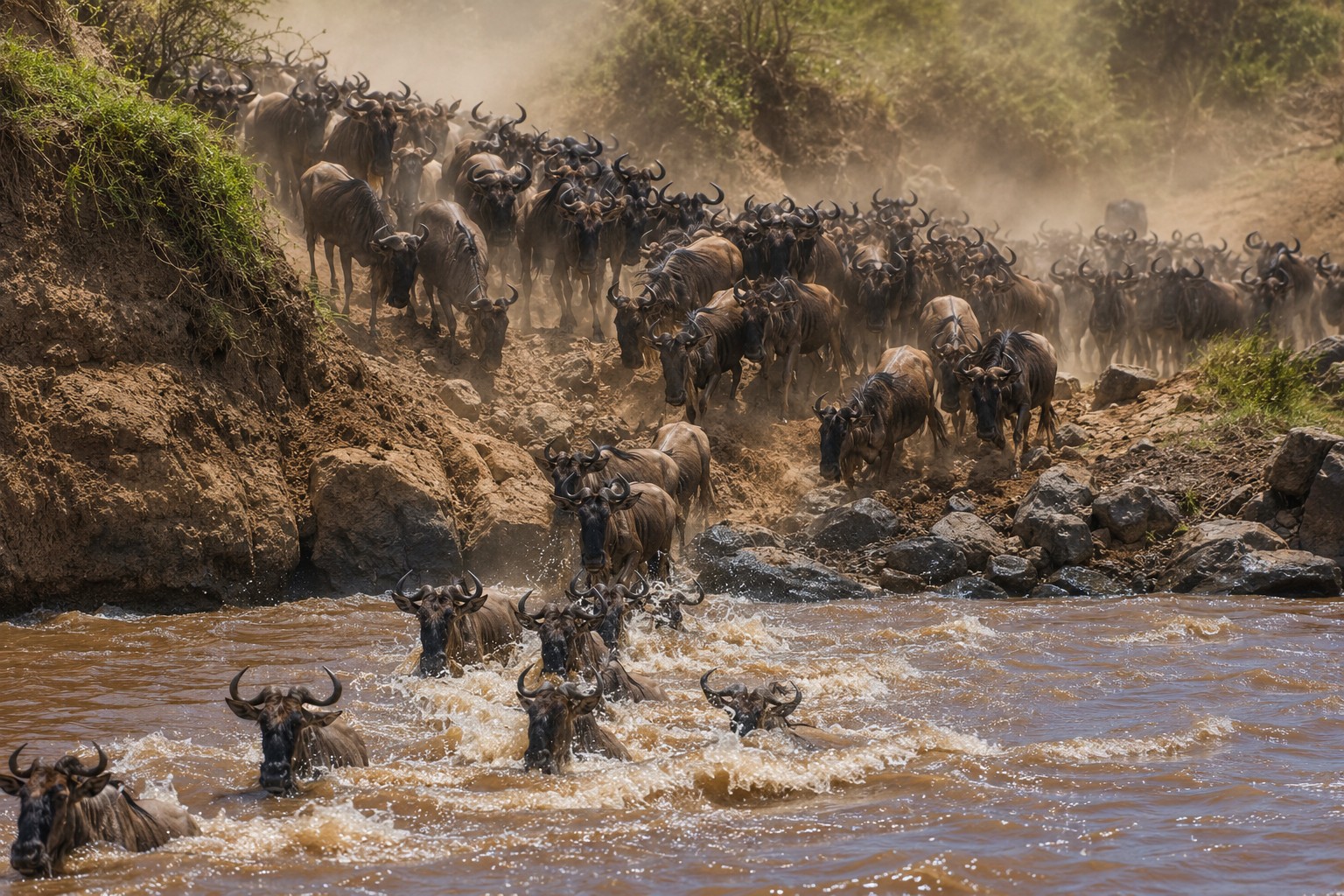
Contrary to popular belief, the Great Migration is not a singular event confined to the famous river crossings. These crossings—where desperate herds plunge into the Mara River facing strong currents and lurking crocodiles—are indeed among the most thrilling moments of the migration. But they represent only a fraction of a far more intricate journey that unfolds all year long.
There is also a widely held misconception that the Great Migration is a neat, clockwise loop through East Africa, packaged perfectly into calendar months. This is misleading. The movements of the herds are unpredictable and influenced by highly localized weather conditions. The plains are vast, and the animals are fickle—and any safari specialist who assures you otherwise is one you should run away from.
The herds do not move in uniform lines or stick to predictable schedules. Their path is shaped by seasonal rainfall and the growth of new grass. It is not uncommon for animals to double back, split off, rejoin, or linger unexpectedly in a particular region.
As veteran guide Richard Knocker explains:
“The migration is not a continuous forward motion. They go forward, backwards, and to the sides. They mill around; they split up; they join forces again. You can never predict with certainty where they will be. The best you can do is suggest likely timing based on past experience—but you can never guarantee the migration 100 percent.”
This means that while it is entirely possible to witness dramatic scenes—river crossings, mass calving, predator hunts—none of it is guaranteed. The best way to appreciate the migration is to understand it as a fluid, evolving expression of nature, not a neatly packaged spectacle.

Fortunately, even without witnessing the migration’s most iconic episodes, the Serengeti and Maasai Mara teem year-round with incredible wildlife. Resident elephants, giraffes, buffalo, and predators ensure that every safari is memorable. The joy of your trip should never hinge on witnessing a single, elusive migration moment.

The migration takes place across the Greater Serengeti-Mara Ecosystem—a vast area spanning northern Tanzania and southern Kenya. The journey typically follows a broadly northward arc from the southern Serengeti through the Western Corridor and Grumeti region and into Kenya’s Maasai Mara—before the cycle reverses southward.
As Richard Knocker cautions:
“Disregard any pretty map you may have been shown that has a tidy flow of animals going round in an annual circle. The migration does not work like this. It is driven entirely by standing water, grazing, and local weather conditions.”
Some key regions to track the herds:
Southern Serengeti & Ndutu region — best for calving season and predator activity (December–March)
Western Corridor & Grumeti River — dry-season grazing and dramatic predator encounters (April–June)
Northern Serengeti & Maasai Mara — famous for Mara River crossings (July–September)
Loliondo & Lobo — transitional zones ideal during shoulder seasons (October–November)
Even when the herds are not following the “normal” pattern due to an unusually dry or wet season, wildlife viewing in any given area remains abundant. Quite literally, millions of animals participate in the Great Migration—so you are sure to encounter thousands of wildebeest, zebras, and gazelles wherever you are.
Timing a visit depends entirely on what kind of experience you seek. Here is a month-by-month breakdown of what to expect:

Best area: Southern Serengeti & Ndutu region
From December to April, the wildebeest prefer the short, grassy plains of the southern Serengeti, where the cropped vegetation offers predators less cover. The volcanic soils here produce mineral-rich grass that generates nutritious milk for newborn calves.
Between January and March, approximately 400,000–500,000 calves are born over just a few short weeks. Within ten minutes of birth, wildebeest calves are standing on their feet — wobbly, but born ready to run. This mass birthing draws an intense concentration of predators into the area, creating some of the most dramatic predator-prey scenes the Serengeti offers.
For travelers hoping to witness newborn calves or intense predator action, February and March are the recommended months. Visitor numbers are also lower, meaning fewer vehicles around, more sightings, and more intimate game viewing.
As the rains ease and the southern and eastern plains dry out, the herds begin drifting north and west toward the Western Corridor and Grumeti River. Not all wildebeest and zebras will follow the same route — some will head toward the Grumeti, while significant numbers may move through Loliondo or via Seronera and Lobo.
This stretch gets a fraction of the attention the Mara crossings attract, but the game viewing and predator action are just as compelling, with far fewer tourist vehicles.

Best area: Maasai Mara & Northern Serengeti
Between July and August, wildebeest move en masse into Kenya’s Maasai Mara, crossing the Mara River in staggering numbers. In a dry year, the first animals can reach the Mara River as early as July; in a wet year, it may be as late as mid-August.
The crossings themselves are extraordinary and entirely unpredictable. Wildebeest may gather nervously on riverbanks for hours, or even days, before one bold individual makes the first leap, prompting a chaotic surge of bodies into water full of waiting crocodiles. Sometimes the herds retreat entirely, only to return and attempt the crossing again later. The action is explosive, messy, and brief—and that fleeting unpredictability is precisely what makes it unforgettable.

July, August, and September represent peak travel season. To secure preferred lodges and operators, book 12 to 18 months in advance. Traveling in October — when school-aged children are back in class — can mean fewer crowds and savings of up to 30% on rates, while wildlife viewing remains strong.
The migration does not simply stop at the Mara. Not all herds even cross into Kenya—some linger in the northern Serengeti where water and grazing remain plentiful.
By October and November, the herds begin working their way south into Tanzania, passing through the eastern and central Serengeti. Rain patterns determine the pace and direction. With the onset of the short rains in November and December, fresh grass begins to sprout in the southern Serengeti — and the cycle begins again.
| When | Where | What to Expect | Crowd Level |
| December–March | Southern Serengeti & Ndutu | Calving season; 400,000–500,000 calves; intense predator activity | Low to moderate |
| April–June | Western Corridor & Grumeti River | Northward push; predator and croc encounters; excellent game viewing | Low |
| July–September | Maasai Mara & Northern Serengeti | Peak season: Mara River crossings; book 12–18 months ahead | High |
| October–November | Central & Southern Serengeti | Return south; there are fewer crowds, which is great for combining Mara and Serengeti. | Moderate |
Travelers generally have two options: stay in one location and let the migration come to you, or follow the herds across regions.

Mobile safari camps move two to three times a year to position guests at prime viewing sites during key migration phases. They offer intimacy and close-range access to wildlife—minimalist luxury at its best.

Permanent lodges remain fixed year-round, offering greater amenities—pools, spas, refined dining—and a stable base from which to explore. Some are strategically positioned along the herds’ most predictable path, making them excellent bases during peak season.
The right choice depends on whether you prioritize proximity to the action or the comfort of a world-class lodge. Either way, the experience can be tailored to your preferences, fitness level, and time of year.
Absolutely — but not only for the fleeting spectacle of a river crossing.
The real magic lies in being immersed in an ever-changing natural drama. An ancient, unpredictable cycle that is raw, profoundly moving, and impossible to replicate anywhere else on Earth. Whether you witness a crossing or not, the Serengeti and Maasai Mara will deliver an experience that stays with you long after you return home.
And with the right guidance from experienced local experts, you will not just witness the Great Migration. You will become part of its story.
What is Africa’s Great Migration?
Africa’s Great Migration is the year-round movement of over 1.4 million wildebeest, accompanied by hundreds of thousands of zebras and gazelles, between Tanzania’s Serengeti and Kenya’s Maasai Mara—a circuit covering roughly 1,200 miles. It is driven by rainfall and grass growth rather than a fixed calendar.
When is the best time to see the Great Migration?
It depends on the experience you want. February and March are best for calving season and predator action in the southern Serengeti. July through September offers the best odds of witnessing a Mara River crossing. October is a quieter, more affordable window that still offers strong game viewing.
Where do the Mara River crossings happen?
Mara River crossings take place along the Mara River, mainly in Kenya’s Maasai Mara and the northern Serengeti, typically between July and October. The exact timing and location of each crossing cannot be predicted in advance.
Can you guarantee seeing a Great Migration river crossing?
No. Even the most experienced guides cannot guarantee a river crossing on a specific date. Wildebeest may wait on the riverbank for hours or days before crossing—or turn back entirely. Flexibility and managed expectations are essential.
How far does the Great Migration travel?
The full circuit covers approximately 1,200 miles between the southern Serengeti in Tanzania and the Maasai Mara in Kenya, though the herds do not follow a fixed route and frequently split, double back, or take different paths.
What animals are involved in the Great Migration?
The Great Migration involves over 1.4 million wildebeest, hundreds of thousands of zebras and gazelles, and the predators that follow them—including lions, leopards, cheetahs, hyenas, and Nile crocodiles.
Is a mobile camp or permanent lodge better for seeing the Great Migration?
Mobile camps follow the herds and offer the closest access to key migration events. Permanent lodges provide more amenities and a stable base. The best choice depends on whether you prioritize proximity to the action or comfort and consistency.
What happens during calving season?
Between January and March, approximately 400,000–500,000 wildebeest and zebra calves are born on the short-grass plains of the southern Serengeti. Wildebeest calves can stand within 10 minutes of birth. Calving season draws intense predator activity and is one of the most dramatic — and underrated — phases of the migration.
Ready to plan your Great Migration safari? Talk to an Out2Safari specialist and get a personalized itinerary built around your travel dates, budget, and what you most want to see — river crossings, calving season, or peaceful low-season game viewing.
👉 Start planning: https://www.out2safari.com/contact
Tell us what excites you
Tell us what drew you to this story and we'll build the journey that puts you in it.